Embodied-SuperMimic

Online world-model learning for robot manipulation

An independent research project maintained by FBddcz
Research preview · Updated November 4, 2026 · Simulation only
Teaser

Watch the film

Selected simulation clips from the BC initialization, teacher and online-Dyna policies. These are demonstrations, not a synchronized or paired episode comparison. Scores refer to separate held-out evaluations; this legacy teaser uses edited playback timing.

What this project tests

Embodied-SuperMimic studies task-specific policies trained through learned differentiable dynamics. It builds on emoPointer's manipulation implementation and the SuperMimic method. Each robot-task expert currently has its own world model and policy. Online simulator transitions refit the model; imagined returns provide policy gradients.

The current evidence is strongest for mug hanging: five teacher baselines, multi-seed online-versus-frozen-model controls on Panda and ARX5, and single-seed Dyna runs on PiPER, UR5e and xArm7. The wider target is five arms across five tasks, followed by five-task training within each robot. This is a target, not a completed benchmark: only eight robot-task cells currently have formal teacher results.

All footage is simulation. The project is independent of the original SuperMimic authors. Algorithm code, reset banks and model weights are being prepared for a separately audited release.

Evidence before scale

79.3%

Teacher baseline on mug_hang

Panda baseline at 4,000 iterations: 203/256 held-out episodes succeed. Legacy broad-random ungrasped starts account for 28/64; this mixed-reset result is not a HOME full-task score.

5 × 5

A full matrix, not selected platforms

Five robots across five tasks is the target. We publish the status of every cell, including physical-validation failures and work not yet trained.

87.1%

Online Dyna on legacy mug_hang

Panda online Dyna at the reported 3,000 iteration label: 87.1 ± 8.1% over three seeds. The matched frozen-world-model control scores 38.4 ± 7.9%.

The online learning loop

1Collect

Run the current policy in simulation and add transitions to replay.

→
2Fit

Refit the robot-task world model on recent replay data.

→
3Imagine

Unroll the learned dynamics with differentiable rewards and a survival model.

→
4Improve

Update the actor through BPTT and train a value bootstrap, then collect again.

What v7 changes

The Dyna experiment initializes dynamics and critic from a trained teacher and initializes the actor by behavior cloning, then continues online collection and model refitting. The frozen-model control uses the same initialization but no further collection or model fitting. Teacher pretraining, BC initialization and online update costs must be counted separately; this is not a matched from-scratch compute claim.

Current scope

Policies consume state, not RGB images. Control uses relative operational-space commands and a gripper signal. The current public release focuses on single-task experts and their controls. A unified five-task policy within each robot is planned, not an established result. Earlier exploratory branches remain archived outside this website release.

What the experiments show

Historical legacy_reset_v0 mixes four reset categories. home_fulltask_v1 development diagnostics finished: 25/25 cells audited, 15 diagnostic-ready, 8 development evaluations completed, 10 blocked; development diagnostics are not official HOME scores. Protocol details.

The strongest controlled comparison so far tests online data collection and model refitting against a frozen-world-model control from the same initialization. Both use BPTT. The numbers below describe these runs, not a guarantee across every task or robot.

Robot / mug hangingOnline DynaFrozen-model controlCompleted seeds
Panda87.1 ± 8.1%38.4 ± 7.9%3 / 3
ARX598.1 ± 1.4%39.8 ± 12.7%3 / 2; one control diverged

Reported at iteration label 3000, with 256 held-out episodes per checkpoint. Values are mean ± standard deviation across training seeds. Teacher pretraining and BC initialization are additional costs. New single-seed robot results are listed in the next table.

Full matrix, explicit progress

TaskPandaARX5PiPERUR5exArm7
Mug hangingTeacher evaluatedTeacher evaluatedTeacher evaluatedTeacher evaluatedTeacher evaluated
Lemon placementTeacher evaluatedTeacher evaluatedTeacher evaluatedContract passedContract passed
Square insertionSmall bank passedSmall bank passedPre-grasp check failedSmall bank passedSmall bank passed
Drawer (preopened place-and-close)IK witness failedSmall bank passedIK witness failedPhysical sequence failedPhysical sequence failed
Box placementSampling insufficientSmall bank passedSampling insufficientSampling insufficientSampling insufficient

Snapshot: November 4, 2026. All 25 environment contracts pass; eight cells have formal teacher results. The 15 newly adapted cells have six successful small development-bank probes and nine failures. A failed small probe does not prove the task is physically impossible, and a contract pass is not task completion. Five-task mixed training within each robot has not started.
Coverage

Embodiments × tasks

EmbodimentDoF + grippermug_hang teacher+ online Dyna (v7)Port status
Panda7 + 2, Franka Hand79.3%87.1 ± 8.1% (3 seeds)complete
ARX56 + 2, parallel gripper97.7%98.1 ± 1.4% (3 seeds)complete
PiPER6 + 2, parallel gripper46.1%85.9% @3000
93.0% @4000
v7 evaluated; 1 seed, 256 held-out episodes; different iteration budgets shown separately
UR5e6 + 2, Robotiq 2F-85*62.5%68.8% @3000
69.9% @4000
v7 evaluated; 1 seed; legacy broad-random type-0 still 0/64 at iteration 4000
xArm77 + 2, xArm gripper*46.5%51.95% @3000
57.81% @4000
v7 evaluated; 1 training seed; legacy type-0 1/64 at 4000

Held-out success on 256 episodes (4 reset categories × 64). These historical mixed-reset scores are not HOME full-task scores. PiPER, UR5e and xArm7 v7 results are single-training-seed runs. @3000 and @4000 are total iteration labels (BC initialization starts at 1000); the latter uses additional training budget. Gallery clips labelled Teacher still show the baseline checkpoint, not the updated v7 policy. Robot-specific reset banks and gripper models differ, so cross-robot score differences do not isolate morphology alone. PiPER’s lemon teacher reached 99.2% held-out, our pipeline-acceptance task; lemon numbers are deliberately not part of this table. * The four-bar gripper linkage is replaced by two prismatic fingers whose open and closed poses are measured from the stock model, so the fingers look detached from the gripper body in renders. Per-finger travel differs across robots (about 3.5 to 4.5 cm). All five embodiments now have full mug_hang reset banks (4 × 10,000 train states; 4 × 256 held-out).

UR5e / xArm7: preliminary diagnostics indicate that the legacy random-start setup affected performance. We plan to retrain from validated safe HOME starts and update the scores when complete.

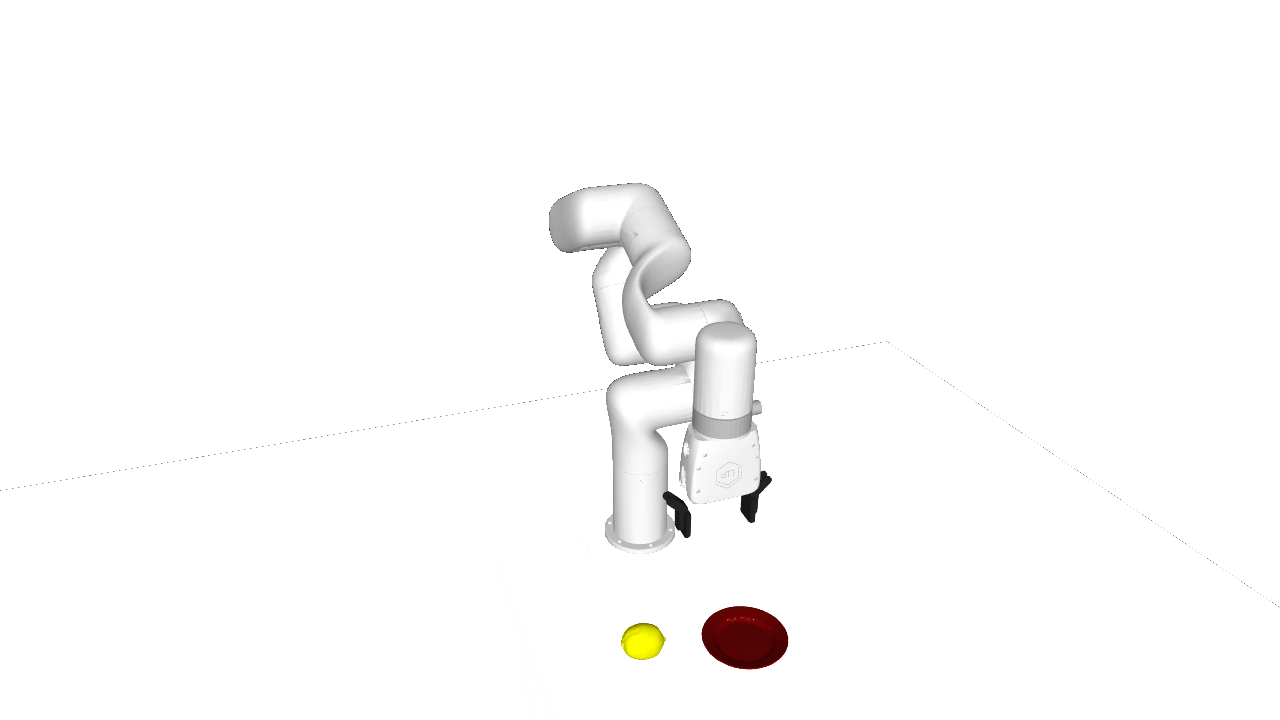
PiPER at a legacy reset posture, not validated HOME
PiPER at reset: reaching forward, approach axis nearly horizontal.
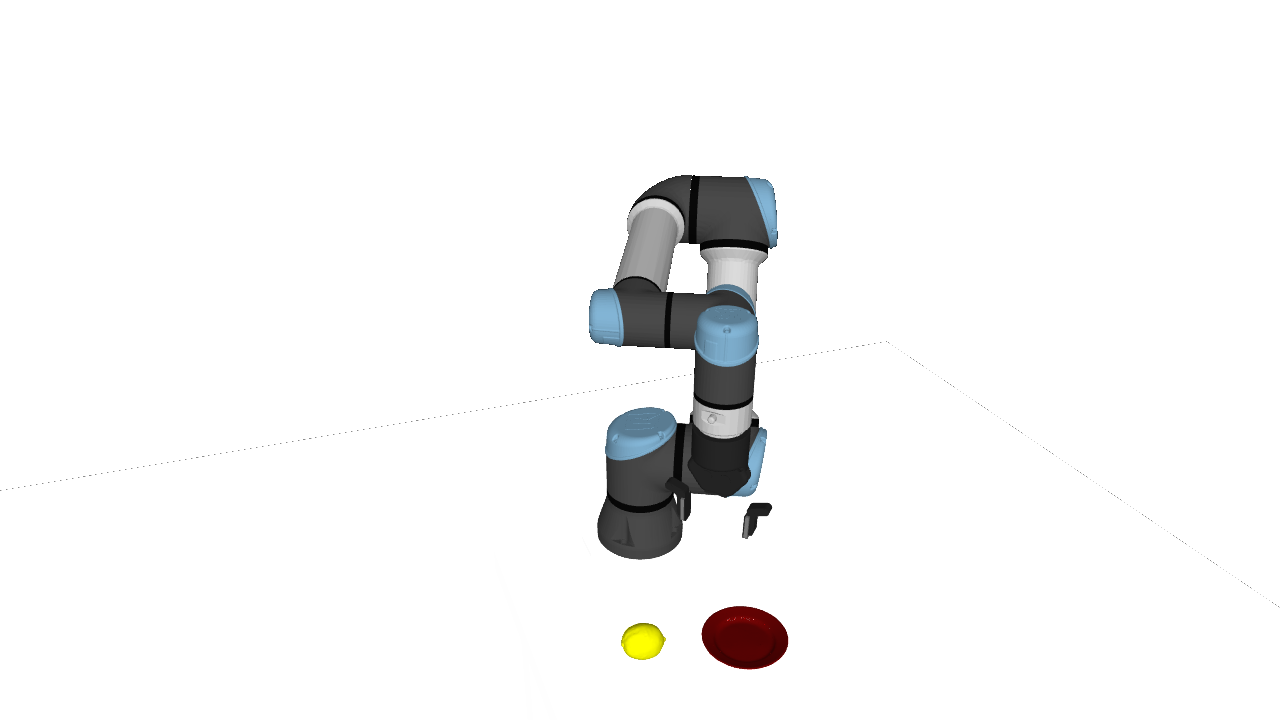
UR5e at a legacy reset posture, not validated HOME
UR5e at reset: elbow-up, gripper pointing straight down.
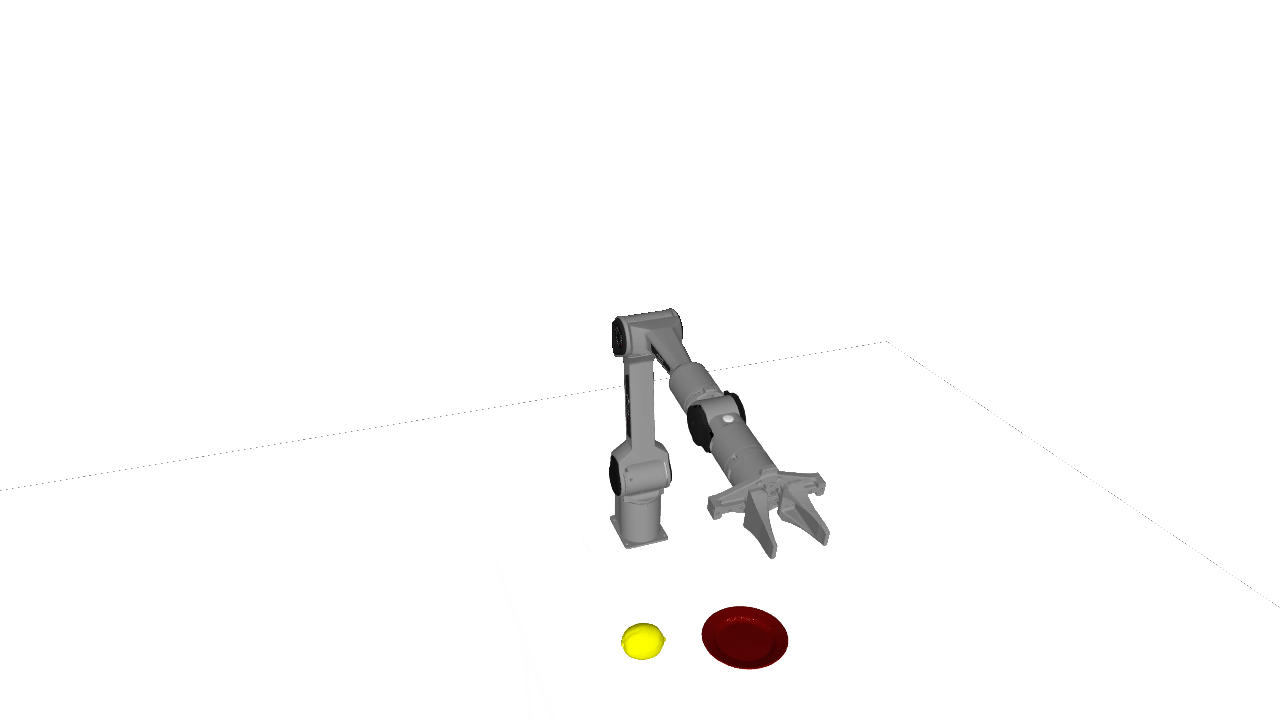
xArm7 at a legacy reset posture, not validated HOME
xArm7 at reset: 7-DoF, gripper pointing straight down.

The full 5 × 5 roadmap

Single-task experts

Panda, ARX5, PiPER, UR5e and xArm7 on mug hanging, lemon placement, square insertion, preopened-drawer place-and-close (not opening), and box placement. Eight of 25 cells currently have formal teacher results.

Physical validation

All 25 environment contracts pass. Small development banks for the 15 new cells pass in six cases and fail in nine as of November 4. Failures remain visible; a contract check is not task completion.

Five tasks within each robot

After individual tasks are validated, test a task-conditioned policy and shared world model within each of the five robots. Compare task-wise success, forgetting and matched training budgets. Not yet trained.

Questions

FAQ

Why not just train the policy offline on collected data?

In our matched controls, keeping replay and the world model frozen degraded policies to 38.4 ± 7.9% on Panda and 39.8 ± 12.7% on two completed ARX5 seeds; one ARX5 seed diverged. These observations are consistent with model exploitation, but are not a claim that all offline model-based policy learning must fail.

Does one policy already perform all five tasks?

No. Current evaluated policies are separate robot-task experts. Each robot's five-task mixed policy is a planned comparison against those experts, not a completed release.

Is the world model frozen during policy updates?

Stop-gradient only inside the policy backward pass, exactly as in the original SuperMimic loop: the model is refit on fresh replay between rounds, but never updated by the policy's gradients.

How is success measured?

Held-out 4×64 resets (seeds 100000), 256 episodes per checkpoint, four difficulty categories — the same protocol for teachers, Dyna runs, and controls.

Sources & release status

This is a research preview maintained by FBddcz. No paper has been published for this project. The website repository contains the static site and selected demonstration footage only; training code, weights and reset banks are being prepared for a separate release.

Website source and release notes