Σ-LeWM: Learning World Models via S-Information for Robot Control
$Σ$-LeWM:通过 S-信息学习世界模型以进行机器人控制
Xinrui Zu、Michael Przystupa、Zhao Yang、Shujian Yu、Kevin Sebastian Luck · arXiv:2611.12732 · 2026-11-09 · cs.LG
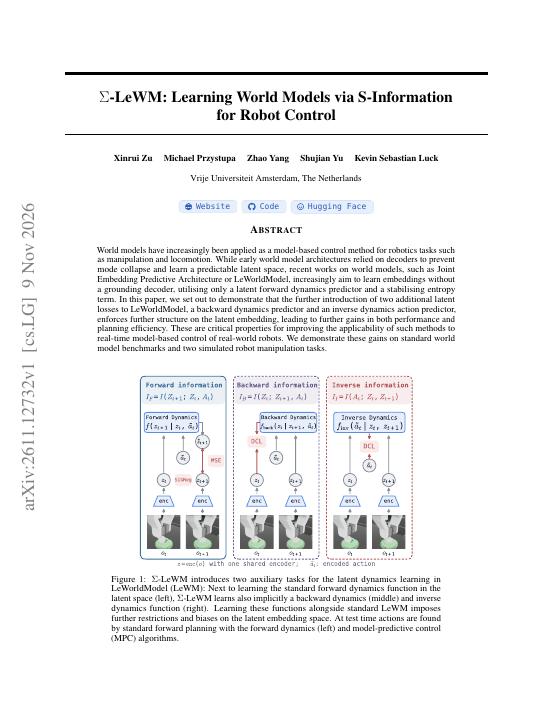
世界模型越来越多地被用作基于模型的控制方法,用于机器人任务(例如操纵和运动)。虽然早期的世界模型架构依靠解码器来防止模式崩溃并学习可预测的潜在空间,但最近关于世界模型的工作,例如联合嵌入预测架构或 LeWorldModel,越来越多地致力于在没有基础解码器的情况下学习嵌入,仅利用潜在的前向动态预测器和稳定熵项。在本文中,我们着手证明,进一步向 LeWorldModel 引入两个额外的潜在损失,即向后动态预测器和
中文为机器翻译节选,以英文原文为准。
English abstract
World models have increasingly been applied as a model-based control method for robotics tasks such as manipulation and locomotion. While early world model architectures relied on decoders to prevent mode collapse and learn a predictable latent space, recent works on world models, such as Joint Embedding Predictive Architecture or LeWorldModel, increasingly aim to learn embeddings without a grounding decoder, utilising only a latent forward dynamics predictor and a stabilising entropy term. In this paper, we set out to demonstrate that the further introduction of two additional latent losses to LeWorldModel, a backward dynamics predictor and an inverse dynamics action predictor, enforces further structure on the latent embedding, leading to further gains in both performance and planning efficiency. These are critical properties for improving the applicability of such methods to…
