Persistent Metric-Semantic Maritime Scene Memory from Open-Vocabulary 3D Scene Graphs
来自开放词汇 3D 场景图的持久度量语义海事场景记忆
Kim Alexander Christensen、Dina Zimmermann、Martin Steinert、Eleni Kelasidi · arXiv:2611.13903 · 2026-11-10 · cs.CV
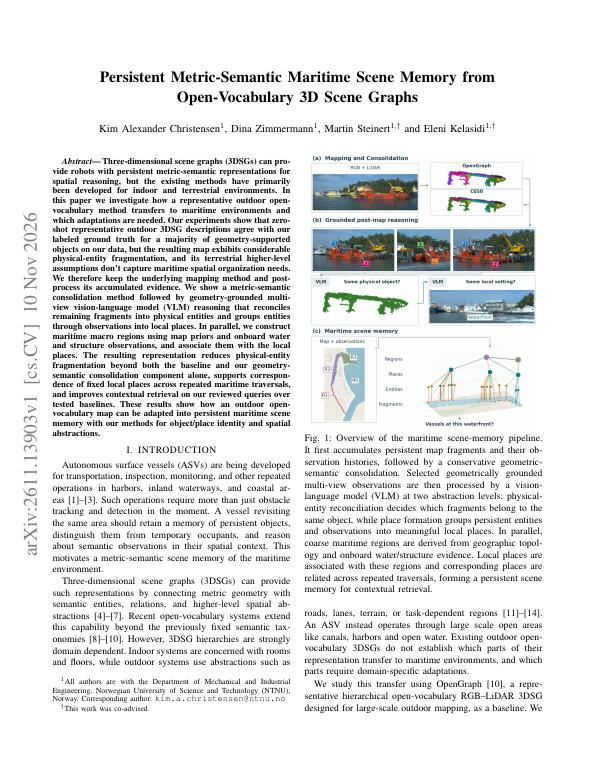
三维场景图(3DSG)可以为机器人提供持久的度量语义表示以进行空间推理,但现有方法主要是针对室内和陆地环境开发的。在本文中,我们研究了代表性的户外开放词汇方法如何转移到海洋环境以及需要进行哪些调整。我们的实验表明,零样本代表性户外 3DSG 描述与我们数据上大多数几何支持对象的标记地面实况一致,但生成的地图表现出相当大的物理实体碎片,其地面更高层
中文为机器翻译节选,以英文原文为准。
English abstract
Three-dimensional scene graphs (3DSGs) can provide robots with persistent metric-semantic representations for spatial reasoning, but the existing methods have primarily been developed for indoor and terrestrial environments. In this paper we investigate how a representative outdoor open-vocabulary method transfers to maritime environments and which adaptations are needed. Our experiments show that zero-shot representative outdoor 3DSG descriptions agree with our labeled ground truth for a majority of geometry-supported objects on our data, but the resulting map exhibits considerable physical-entity fragmentation, and its terrestrial higher-level assumptions don't capture maritime spatial organization needs. We therefore keep the underlying mapping method and post-process its accumulated evidence. We show a metric-semantic consolidation method followed by geometry-grounded multi-view…
