Is Your Robot's Memory Just a Clock? Temporal Shortcuts in Memory-Augmented VLA Policies
你的机器人的记忆只是一个时钟吗?内存增强型 VLA 策略中的时间快捷方式
Chubin Zhang、Bo An · arXiv:2611.14488 · 2026-11-10 · cs.RO
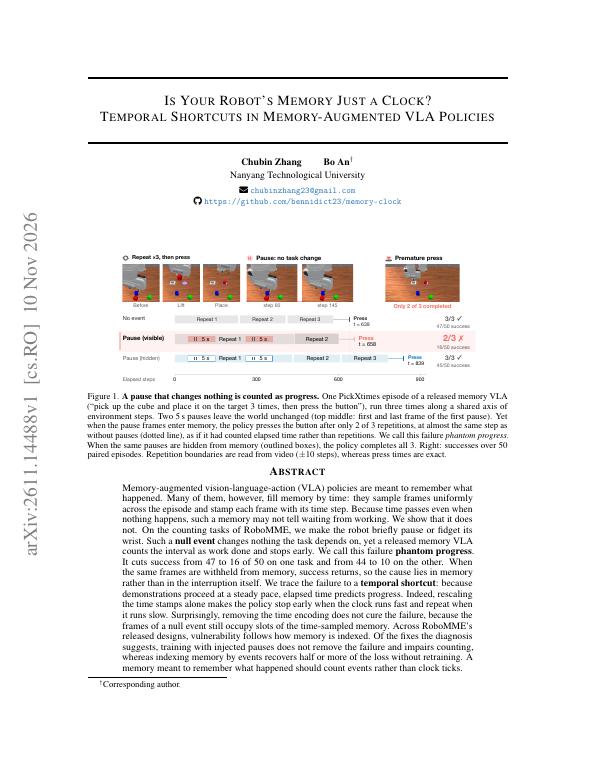
记忆增强视觉-语言-行动(VLA)策略旨在记住发生的事情。然而,其中许多都是按时间填充记忆的:它们在整个剧集中均匀地采样帧,并用时间步长标记每个帧。因为即使什么也没发生,时间也会流逝,这样的记忆可能无法区分等待和工作。我们证明事实并非如此。在 RoboMME 的计数任务中,我们让机器人短暂停顿或摆弄手腕。这样的空事件不会改变任务所依赖的任何内容,但已释放的内存 VLA 会将时间间隔计为完成的工作并提前停止。我们称这种失败为幻影进步。一项任务的 50 次成功率从 47 次减少到 16 次
中文为机器翻译节选,以英文原文为准。
English abstract
Memory-augmented vision-language-action (VLA) policies are meant to remember what happened. Many of them, however, fill memory by time: they sample frames uniformly across the episode and stamp each frame with its time step. Because time passes even when nothing happens, such a memory may not tell waiting from working. We show that it does not. On the counting tasks of RoboMME, we make the robot briefly pause or fidget its wrist. Such a null event changes nothing the task depends on, yet a released memory VLA counts the interval as work done and stops early. We call this failure phantom progress. It cuts success from 47 to 16 of 50 on one task and from 44 to 10 on the other. When the same frames are withheld from memory, success returns, so the cause lies in memory rather than in the interruption itself. We trace the failure to a temporal shortcut: because demonstrations proceed at a…
